1.
Feature
Story
/ Bob Barker -
TVI's
PERSON OF THE WEEK and NBS100
Winner •
•Robert William Barker
was born (December 12, 1923) in
Darrington, WA, and spent most of
his youth in South Dakota where
his mother was a schoolteacher.
His family eventually moved to
Springfield, Missouri, where he
attended high school and Drury
College on a basketball
scholarship. •
•When
World War II interrupted his
studies, he became a Navy fighter
pilot, but the war ended before
he was assigned to a seagoing
squadron. He returned to Drury
College in 1947, and after
graduating with a degree in
economics, he went to work for a
radio station in Palm Beach,
Florida. •
•A year
later, in 1950, Barker moved to
Los Angeles, in order to pursue a
career in broadcasting. He hosted
an audience-participation radio
show on KNX (AM), and became the
host of his own radio program,
"The Bob Barker Show." •Bob
Barker was a handsome young
hotshot In 1956 when he made his
debut on national television as
the host of the popular "Truth or
Consequences," replacing the
balding veteran Jack Bailey. •
•Game
Show producer "'Ralph Edwards,"
the show's originator, had sold
the show to NBC as a daytime
strip, but he had not chosen a
host. •
•He
auditioned other hosts in
Hollywood and New York for weeks,
but when he heard The Bob Barker
Show on his car radio, he liked
Barker's voice and style and knew
he had found the man for the job.
And proving that Edwards had
chosen him wisely.
- CONTINUED•
TVI Magazine is not responsible for the
content of external InterNet sites Continued02 •
1999
- In December 1999, had his Hollywood home
- a 1929 5,000-sq.-ft. Spanish Colonial
Revival-style house - designated a
historic-cultural monument by the city of
Los Angeles. •
2001
- Barker and Syd Vinnedge, a senior
executive with FremantleMedia (formerly
Pearson Television) presented $500,000 to
the Harvard Law School to fund courses on
animal rights law. The gift is being given
by FremantleMedia in honor of Barker's 30
years as host of "The New Price Is Right"
(1972) and his long involvement with the
animal rights movement. FremantleMedia
produces Barker's long-running CBS game
show.
•
2002
- Appeared on "The Wayne Brady Show" for
his 80th Birthday.
•
2002
- Six weeks after recovering from a
stroke, he was in another health crisis
when he underwent prostate surgery at
George Washington University Hospital in
Washington, D.C., to remove his enlarged
prostate. His third operation was so
successful that he recovered just in time
for him to go back to work.
•
2004
- Inducted into the Academy of Television
Arts & Sciences Hall of Fame in May
2004 by Dick Askin, Chairman & CEO of
the Academy of Television Arts &
Sciences. Askin is also President &
CEO of Tribune Entertainment Company.
•
2006
- Retirement: On October 31, 2006, Barker
announced his retirement as host of "The
New Price Is Right" effective June, 2007.
He later announced the date would be June
15th.
•
2006
- In 2006, he donated $1,000,000 to
Georgetown University to endow a fund at
its law school that will focus on the
study of animal rights.
•
2007
- At age 83, Barker taped his final "The
Price Is Right" episode on 6 June 2007;
the episode aired on 15 June 2007.
•
2007
- CBS announced in July of 2007 that
comedian Drew Carey would replace Barker
as host of "The Price Is Right
•
2008
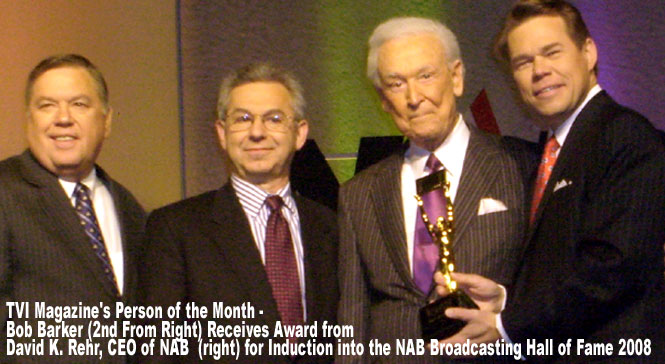
- Inducted in the NAB Broadcasting Hall of
Fame during the NAB Show Television
Luncheon on Monday, April 14, in Las
Vegas.
CENTER
PAGE
-
Remarks
of FCC Chairman Kevin J. Martin at CTIA
Wireless
2008••
And, as of May 2007, approximately 82
percent of the U.S. population lived in an
area of the country covered by at least
one of these mobile broadband
networks.
• •
• In addition, as of December
31, 2006, there were 22 million mobile
wireless devices capable of accessing the
Internet at broadband speeds in use in the
United States, up from only three million
the year before.
• •
• We've also seen the
introduction of innovative new products
during the past year, such as the iPhone,
which is truly a handheld mobile computer.
The iPhone can seamlessly connect to any
Wi-Fi hot spot for Internet access
service. And almost two million iPhones
have been activated on AT&T's network.
-- CLICK
FOR MORE RFid Story
• •
Importantly, competition in the
wireless industry has also led to lower
prices, higher usage and adoption rates,
and technological innovation. And many of
you in this room have been instrumental in
bringing the benefits of competition to
American consumers. Your contributions to
improving wireless services for the
American consumer have not gone
unnoticed. •
• The FCC has an important
role to play in this mobile revolution as
well.
• •
During my tenure as Chairman, the
FCC has made vast amounts of spectrum
available for the next generation of
innovative wireless services. Since 2006,
we have more than doubled the amount of
spectrum previously made available for
mobile wireless services.
• •
Most recently, the Commission
auctioned spectrum in the 700 MHz band.
The sheer size of the 700 MHz Auction is a
harbinger of the benefits to come. The
Auction was the largest in FCC history and
raised a record $19.592 billion in total
bids.
• •
Even in a difficult economic
climate, revenues raised in this auction
easily exceeded congressional estimates of
about $10 billion &endash; nearly doubling
the amount Congress had anticipated would
be raised. CLICK
FOR MORE RF-ID STORY
• •
• The Auction drew
wide-ranging interest from a number of new
players. A bidder other than a nationwide
incumbent won a license in every
market. •
• At the same time, we also
must ensure that our regulations continue
to protect consumers in this new, more
mobile world. Indeed, in some ways the
wireless industry is a victim of its own
success. Because with increased success
often comes increased expectations.
• •
Today, to your credit, wireless is
no longer seen as a luxury, but as a vital
means of everyday communication. And the
public has growing expectations of how
they will be able to use wireless to meet
their everyday needs. For example, E911
ensures that when someone dials 911 during
an emergency, public safety can easily and
reliably find them. To achieve that goal,
we need to ensure that our enhanced 911
rules provide meaningful automatic
location information that permits first
responders to reliably find them.
• •
We all know that people are relying
on cell phones for more and more of their
calls, including calls to 911. CTIA
estimates that since the 1996
Telecommunications Act, 911 calls placed
annually from wireless phones have
increased six fold (from 55,000 to
290,000). The advances in wireless
technology allow people to call for help
more quickly and from more remote places
than ever before. We need to make sure
that our location accuracy requirements
keep apace with these changes so that
consumers can take advantage of all the
opportunities wireless technology has to
offer.
• •
I believe this is an opportunity
for the wireless industry and a harbinger
of even more success. In the end, I am
confident the wireless industry will rise
to the occasion and I look forward to
working with you and my fellow
commissioners on this critical public
safety issue.
• •
Thank you for your time today. I
truly appreciate the invitation to be
here. CLICK
FOR MORE VERIZON'S CEO IVAN
SEIDENBERG 4.
Related
StoriesLobbyist, Eddie
Frittz of Kentucky Roast FCC Chairman
Martin, Then Jabs At
Cable
•
•
It was reported by Ted Hearns of
Multichannel Industry News in December
2007, -- only someone like - Washington
D.C.'s super lobbyist Eddie Fritts gets to
take a few cost-free shots at Federal
Communications Commission chairman Kevin
Martin, who, as the cable industry knows
all too well, isn't afraid of playing by
north Jersey mob rules when shown up in
public.
•
•Fritts -- former boss of the
National Association of Broadcasters now
running his own firm -- gave it his best
shot Wednesday night at a roast in
Martin's honor attended by 1,500 lawyers,
lobbyists, and others who routinely seek
favors from the national media regulator.
The evening is officially known as the
annual FCC Chairman's Dinner, organized by
the Federal Communications Bar Association
to raise money for charitable
causes. •
•Martin got to return fire later
&endash; but instead of putting Fritts in
his place, Martin at times opted to poke
fun at cable and other industries within
his regulatory
orbit.
•
•In his trademark Mississippi
drawl, Fritts reeled off a bunch of
one-liners, including a few aimed at
Martin's youthful
appearance.
•
•"I've known Kevin since he was
25 years old and looking 12 years old.
Let's be honest, Kevin looks so young even
Mark Foley would throw him back," Fritts
said, referring to the disgraced House
Republican from Florida who had to resign
over scandalous text messages exchanged
with young
boys.
•
•Pausing between cracks to let
the crowd settle down in the giant
ballroom of the Washington Hilton, Fritts
also reminded everyone of Martin's ongoing
"war" with the cable industry. He
collected more groans than laughs by
linking Sen. Larry Craig's (R-Idaho)
airport bathroom arrest to Martin's demand
that cable had met the so-called 70/70
test in federal
law.
•
•"You know, a lot of people
think 70/70 gives Kevin a mandate on a la
carte. Not true. The only one is
Washington who has a mandate is Larry
Craig," Fritts
said.
•
•Fritts referred to the recent
news that Energy and Commerce Committee
chairman Rep. John Dingell (D-Mich.) is
investigating Martin's management of the
agency. Martin got word in a letter from
Dingell &endash; a missive famously known
in Washington telecom circles as a
"Dingell-gram."
•
•"I spoke to Kevin on Monday and
asked if he had recently received a
Dingell-gram," Fritts began. "He said,
`Yes.' I asked if it hurt and he
responded, 'Yes.' And he also recommended
that all men over age 50 get a
Dingell-gram at least once a
year." •
•When it was Martin's turn, he
started off with a little humility about
his defeat to the cable industry last
Tuesday on the matter of how big cable had
grown.
•
•"I recognize that I've brought
some of my recent problems on myself --
for example, my cable choice proposal, you
know, the one where cable gets to choose
to do whatever I say. That may not have
been my best idea," Martin
quipped.
•
•At one point, Martin asked all
cable lobbyists in the room to raise their
hands. "I want to start out by apologizing
that we had to remove the knives from your
table," he
said.
•
•Martin suggested that cable
opened its checkbook to defeat his
anti-cable
initiatives.
•
•"I don't know how much money
the cable industry has spent but I do know
that if our country goes into a recession,
it won't be my fault," he
said.
•
•Martin also used Comcast
chairman and CEO Brian Roberts as a foil
in a gag about people who complain that
Martin laced one of his public statements
with the
F-word.
•
•"But not everyone was so
critical," Martin said. "Brian Roberts
called and suggested I do my own show on
leased access channels. I told him that's
way too expensive. Then I thought, `Maybe,
I can fix that," Martin said, referring to
last Tuesday's ruling to slash leased
access rates by
70%.
•
•Martin cracked that he would
call his program the "That 70/70 Show" and
his first episode "Cooking the
Numbers."
•
•Martin concluded with a wacky
top 10 list of predictions for the
upcoming 700 MHz spectrum
auction.
•
•Following the auction, he said:
AT&T will say the auction results
prove that network neutrality is not
necessary. Google will say the outcome
proves network neutrality is necessary.
NAB will say the auction shows that the
XM-Sirius merger should not be
approved.
•
•Posted by Ted Hearn on December
7, 2007 | Comments
(0)CLICK
FOR MORE RELATED STORY - Michael Powell,
former Chairman of the
FCC.•
5.
NBS100 Review WiFi / Land-lines NBS100
TeleComunication Study - Regulatory
Frequency Seizure
•
Andrew Carnegie (November
25, 1835 -- August 11, 1919) was a
Scottish-born American businessman, a
major philanthropist, and the founder of
the Carnegie Steel Company which later
became U.S. Steel. He is known for having
built one of the most powerful and
influential corporations in United States
history, and, later in his life, giving
away most of his riches to fund the
establishment of many libraries, schools,
and universities in Scotland, America and
worldwide. CLICK
FOR MORE WALL STREET - 1902
STORY