top
ˆ
top
ˆ
•
ˆ
•
top
ˆ
•
|
Editor's Note - Scientific American, May
24, 1902, page 363: If the
publishersBY and the author WALDON FAWCETT of this
1902 Scientific American article would have known what they
know today about Antennas, and the difference between the
Electromagnetic radio wave energy derived from batteries,
and the EW radio wave created by spark generators, the
italicized article paragraph would have read as follows:
"The Stubblefield wireless
telephony system differs from Marconi's telegraphy system in
that, Stubblefield's unit sends voice and music that employs
a low powered continuous EMw or RW radio wave that is
produced by an intense e-field or 'virtual antenna' created
by several Stubblefield coils buried in earth. Attached to
Stubblefield's pole-like coil aerials, is his wireless
telephone transmitter and receiver that enables him to send
and receive audible voice signals anywhere from the
surrounding atmospheric charge environment. "This is because
there is a 'virtual antenna' caused by the aerial being
earthed in the ground."
The energized aerial of same
proportions, at different locations, enables land lines,
vehicles or ships to pick up the atmospheric voice signals
broadcast by the NBS wireless unit. The distant is control
by amplitude modulation, the bigger the battery, the longer
the distance the signal travels. Intense e-fields are
another way of saying "high votlage."
As for low powered continuous EMw
or RW radio waves created in the earth, today's radio wave
frequencies are generated by electrons accelerating in the
antenna.
Consider your wireless telephone
transmitter your hold in your hand is perpendicular to the
ground. When your voice is applied into the wireless
mouthpiece, the electrons in the antenna are changing their
velocities continuously (i.e. moving up and down very
quickly) in response to your applied voice signal. For a
radio station that broadcasts voice and music at a
wavelength or frequency of 1500m, the antenna needs to be
750m long. This is because, like Stubblefield original
wireless telephone concept, there is a 'virtual antenna'
caused by the aerial being earthed in the ground, attatched
to a mesh-like fish net made of metal.
As for the Marconi telegraphy unit,
it can not send voice signals, because it
utilizes a turbine driven electric generator that produces
static electricity and the type of Hertzian EMw or radio
wave signal that has to be connected, then disconnected by
the operator, to emulate the Dit, Dah (Dot, Dashes)
Morse Code signals being transmitted into the atmosphere,
and which, by the way, it is now claimed, is more
susceptible to derangement by electrical disturbances than
the been continuous undampened currents found and in the
earth and water.
OK, so what IS Static
Electricity and E-fields? - Click For More Before Reading
1902 Article
Scientific
American, May 24, 1902, page 363:
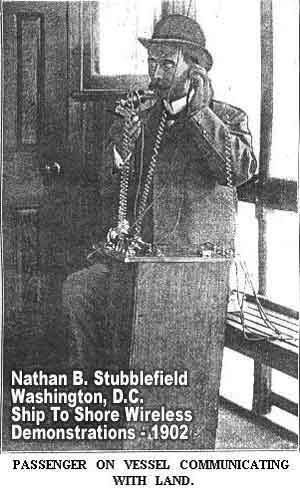
Photos: Nathan Nathan Stubblefield is pictured
in1902, with his wireless telephony and aerial system that
enabled him to transmit voice signals into the atmosphere
from ship to shore.
Top photo shows Stubblefield during the first ship
to shore VOICE radio broadcast in the world. Stubblefield's
first wireless telephony transmissions were commenced in
1892, in Murray, Kentucky. His voice electromagnetic radio
signals were transmitted and received, using his own
patented earth batteries that transmitted undampened
continuous EM waves, connected to the aerials pictured in
center photo.
THE LATEST ADVANCE IN
WIRELESS TELEPHONY.
BY WALDON
FAWCETT.
The latest and one of the most
interesting systems of wireless communication with which
experiments have recentlyonducted is the invention of Nathan
Stubblefield, of Murray, Ky., an electrical engineer who is
the patentee of a number of devices both in this country and
abroad. *The Stubblefield system differs
from that originated by Marconi in that utilization is made
of the electrical currents of the earth instead of the
ethereal waves employed by the Italian inventor, and which,
by the way, it is now claimed, are less powerful and more
susceptible to derangement by electrical disturbances than
the been c currents found in the earth and water. In this
new system, however, as in that formulated by Marconi, a
series of vibrations is created, and what is known as the
Hertzian electrical wave currents are used.
The key to the methods which form
the basis of all the systems of wireless telephony recently
discovered--the fundamental principles of wireless
telephony, as it were--was discovered at Cambridge, Mass.,
in 1877 by Prof. Alexander Graham Bell, the inventor of the
telephone system which bears his name. On the occasion
mentioned Prof. Bell was experimenting to ascertain how
slight a ground connection could be had with the telephone.
Two pokers had been driven into the ground about fifty feet
apart, and to these were attached two wires leading to an
ordinary telephone receiver. Upon placing his ear to the
receiver, Prof. Bell was surprised to hear quite distinctly
the ticking of a clock, which after a time he was able to
identify, by reason of certain peculiarities in the ticking,
as that of the electrical timepiece at Cambridge University,
the ground wire of which penetrated the earth at a point
more than half a mile distant.
Some five years later Prof. Bell
made rather extensive experiments along this same line of
investigation at points on the Potomac River near
Washington, but these tests were far from satisfactory. It
was found on this occasion that musical sounds transmitted
by the use of a "buzzer" could be heard distinctly four
miles distant, but little success was attained in the matter
of communicating the sound of the human voice. Meanwhile Sir
William Preece, of England, had undertaken experimental
study of the subject of wireless telephony, and during an
interval when cable communication between the Isle of Wight
and the mainland was suspended, succeeded in transmitting
wireless messages to Queen Victoria at Osborne by means of
the earth and water electrical currents.
 Mr.
Stubblefield's experiments with wireless telephony dated
from his invention of an earth cell several years ago. This
cell derived sufficient electrical energy from the ground in
the vicinity of the spot where it was buried to run a small
motor continuously for two months and six days without any
attention whatever. Indeed, the electrical current was
powerful enough to run a clock and several small pieces of
machinery and to ring a large gong. Mr. Stubblefield's first
crude experiments looking to actual wireless transmission of
the sound of the human voice were made without ground wires.
Nevertheless, by means of a cumbersome and incomplete
machine, without an equipment of wires of any description,
messages were transmitted through a brick wall and several
walls of lath and plaster. As the development of the system
progressed, the present method of grounding the wires was
adopted, in order to insure greater power in
transmission. Mr.
Stubblefield's experiments with wireless telephony dated
from his invention of an earth cell several years ago. This
cell derived sufficient electrical energy from the ground in
the vicinity of the spot where it was buried to run a small
motor continuously for two months and six days without any
attention whatever. Indeed, the electrical current was
powerful enough to run a clock and several small pieces of
machinery and to ring a large gong. Mr. Stubblefield's first
crude experiments looking to actual wireless transmission of
the sound of the human voice were made without ground wires.
Nevertheless, by means of a cumbersome and incomplete
machine, without an equipment of wires of any description,
messages were transmitted through a brick wall and several
walls of lath and plaster. As the development of the system
progressed, the present method of grounding the wires was
adopted, in order to insure greater power in
transmission.
The apparatus which has been used in
the most recent demonstrations of the Stubblefield system,
and which will be installed by the Gordon Telephone Company,
of Charleston, S. C., for the establishment of
telephonic communication between the city of Charleston and
the sea islands lying off the coast of South Carolina,
consists primarily of an ordinary receiver and transmitter
and a pair of steel rods with bell-shaped attachments which
are driven into the ground to a depth of several feet at any
desired point, and which are connected by twenty or thirty
feet of wire to the electrical apparatus proper. This latter
consists of dry cells, a generator and an induction coil,
and the apparatus used in most of the experiments thus far
made has been incased in a box twelve inches in length,
eight inches wide and eighteen inches in height. This
apparatus has demonstrated the capability of sending out a
gong signal as well as transmitting voice messages, and this
is, of course, of great importance in facilitating the
opening of communication.
The most interesting tests of the
Stubblefield system have been made on the Potomac River near
Washington. During the land tests complete sentences,
figures, and music were heard at a distance of several
hundred yards, and conversation was as distinct as by the
ordinary wire telephone. Persons, each carrying a receiver
and transmitter with two steel rods, walking about at some
distance from the stationary station were enabled to
instantly open communication by thrusting the rods into the
ground at any point. An even more remarkable test resulted
in the maintenance of communication between a station on
shore and a steamer anchored several hundred feet from
shore. Communication between the steamer and shore was
opened by dropping the wires from the apparatus on board the
vessel into the water at the stern of the boat. The sounds
of a harmonica played on shore were distinctly heard in the
three receivers attached to the apparatus on the steamer,
and singing, the sound of the human voice counting numerals,
and ordinary conversation were audible. In the first tests
it was found that conversation was not always distinct, but
this defect was remedied by the introduction of more
powerful batteries. A very interesting feature brought out
during the tests mentioned was found in the capability of
this form of apparatus to send simultaneous messages from a
central distributing station over a very wide territory.
Extensive experiments in wireless
telephony have also been made by
*Prof.
A. Frederick Collins, an electrical engineer of
Philadelphia, whose system differs only in minor details
from that introduced by Mr. Stubblefield. In the Collins
system, instead of utilizing steel rods, small zinc-wire
screens are buried in the earth, one at the sending and
another at the receiving station. A single wire
connects the screen with the transmitting and receiving
apparatus, mounted on a tripod immediately over the shallow
hole in which the screen is stationed. With the Collins
system communication has been maintained between various
parts of a large modern office building, and messages have
been transmitted without wires across the Delaware River at
Philadelphia, a distance of over a mile.
* His
Canadian patents were later sold to Prof. Arthur Frederick
Collins, an electrical engineer of Philadelphia, Stock in
various Arthur Collin Companies, one of them being,
Continental Wireless Telegraph & Telephone Co., whose
Telecom assets were later merged into the AT&T group of
companies in 1913. See Photo featuring the NBS group of
scientists, inventors and Telephone executives in 1902 at
Belmont Park. Collins is pictured far left. Tesla is
standing six from Right.
OK, so
what IS Static Electricity? -
1. Static electricity is a field
of science. Some people call it "Electrostatics." Same
thing, is that
correct?.
So, if Static Electricity is a kind of science, then
it can't be made by generators, is that correct?. Ok, I see
what your getting at: Let's take zoology as an example. You
can dissect a dead frog, but you'll never find any biology.
And rocks don't contain any tiny pieces of "geology."
Remember: hydrostatics is the study of fluid pressure,
Newtonian Statics is the study of physical forces, and
Static Electricity is the study of charge, voltage, and
electrical forces. Where can we find static electricity? In
physics books... and in buildings at the University!
2. Static electricity is a set of
events which humans have grouped
together.
Sparks and lightning are "static electricity," even
though sparks and lightning are about the most dynamic
things imaginable. Also, "dryer cling" is static
electricity. The cling effect, THAT is the electricity.
After all, "electricity" can mean "a class of phenomenon,"
and having your socks stick to the back of your sweater is
certainly a phenomenon. Where does static electricity come
from? From human minds: same as with "weather" and
"bureaucracy" and other classes of phenomenon.
3. Static electricity is another
word for high
voltage.
Whenever we have high voltage, then we also have
electrostatic attraction and repulsion. High voltage can
attract lint or tiny bits of paper, and it can make hair
stand up. With high voltage we also get long sparks,
crackling noises, and blue glows and flashes. High voltage
makes ozone; the stuff that gives that funny chlorine smell.
These things are the hallmarks of Static Electricity, but
they are never caused by the "static-ness" of electric
charges. Instead they are caused by intense e-fields.
Intense e-fields are another way of saying "high votlage."
If you can scuff your shoes on the carpet and then zap
people with your finger, then you've been charging your body
to several thousand volts.
4.Static Electricity means an
imbalance of electric charge
Electrically neutral matter contains closely-spaced
electrons and protons. The "positives" and the "negatives"
are very close together, so their effects cancel out. That's
why electrical phenomena don't seem obvious in the everyday
world. But if we accidentally remove a bunch of electrons
from their atoms, then put these electrons in a distant
spot, we'll create a region of positive net charge. We'll
also create an equal region of negative net charge. These
imbalances of charge will surround themselves with intense
e-fields. Click
For More
ByLines:
Editors Note
Marconi's spark
generated EM waves, proporidly transmitted the Dit Dah,"S"
two weeks prior to Stubblefield's first of 10 demonstration
in January, 1902, held in Kentucky, Washington, D.C.,
Philadelphia and in New York. Five more were held by Collins
and Tesla during the same year, using the same NBS wireless
devices pictured.
More Articles
• Converging
News 172005 / TeleCom Buy Outs and Asset Seizure
Boom
Respectfully
Submitted
Josie
Cory
Publisher/Editor
TVI Magazine
TVI Magazine,
tviNews.net, YES90, Your Easy Searh, Associated Press,
Reuters, BBC, LA Times, NY Times, VRA's D-Diaries, Industry
Press Releases, They Said It and SmartSearch were used in
compiling and ascertaining this Yes90 news report.
©1956-2005. Copyright. All rights
reserved by: TVI Publications, VRA TelePlay Pictures, xingtv
and Big Six Media Entertainments. Tel/Fax: 323
462.1099.
We Preserve The
Moment
Return
ˆ
To Top
|
|
We Preserve The Moment
Yes90 tviNews
•
Reprint from Scientific American, May
24, 1902, page 363: BY WALDON
FAWCETT
•
The Latest Advance in Wireless Telephony (1902)
Nathan B. Stubblefield • OK,
so what IS Static
Electricity?
/ Television
International Magazine's Person Of The Week POW
•
172005 - /
NEWS Convergence -
17th Week of 172005 /
Feature
Story
•
109NBSScienceFawcett1902.htm Smart90,
s90tv, lookradio, tvimagazine, dv90, vratv, xingtv,
Ddiaries, nbs100, Look Radio, Josie Cory,
Television
With No Borders
|
|
|
|
Legal
Notices Copyright
Information
How
Do We Do Business?
Tel
323 462-1099
SEND
E-MAIL
Return
ˆ
To
Top
|
|
|