|
TVI Magazine is
not responsible for the content of
external InterNet sites
1.
Feature
Story
/
China
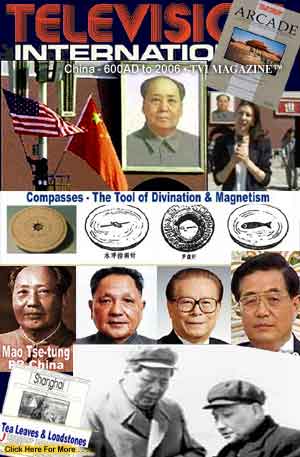
Events 1950 to 1976
02.
TIMELINE
-
•
1949 / 10 -
The Soviet Union recognized the People's
Republic on October 2, 1949. Earlier
in the year, Mao Tsetung had proclaimed
his policy of "leaning to one side" as a
commitment to the socialist bloc.
•
1950 - Tibet
becomes part of the People's Republic of
China.
•
1950 / 02 - In
February 1950, after months of hard
bargaining, China and the Soviet Union
signed the Treaty of Friendship, Alliance,
and Mutual Assistance, valid until 1980.
The pact also was intended to counter
Japan or any power's joining Japan for the
purpose of aggression.
•
1950 / 10 - By
1950 international recognition of the
Communist government had increased
considerably, but it was slowed by China's
involvement in the Korean War. In October
1950, sensing a threat to the industrial
heartland in northeast China from the
advancing United Nations (UN) forces in
the Democratic People's Republic of Korea
(North Korea), units of the PLA--calling
themselves the Chinese People's
Volunteers--crossed the YaluJiang () River
into North Korea in response to a North
Korean request for aid. Almost
simultaneously the PLA forces also marched
into Xizang to reassert Chinese
sovereignty over a region that had been in
effect independent of Chinese rule since
the fall of the Qing dynasty in 1911.
•
1951 / 00 - In
1951 the UN declared China to be an
aggressor in Korea and sanctioned a global
embargo on the shipment of arms and war
materiel to China. This step foreclosed
for the time being any possibility that
the People's Republic might replace
Nationalist China (on Taiwan) as a member
of the UN and as a veto-holding member of
the UN Security Council.
•
1951 / 12 -
1951-52 drive against political enemies
was accompanied by land reform, which had
actually begun under the Agrarian Reform
Law of June 28, 1950. The redistribution
of land was accelerated, and a class
struggle landlords and wealthy peasants
was launched. An ideological reform
campaign requiring self-criticisms and
public confessions by university faculty
members, scientists, and other
professional workers was given wide
publicity. Artists and writers were soon
the objects of similar treatment for
failing to heed Mao Tsetung's dictum that
culture and literature must reflect the
class interest of the working people, led
by the CCP.
•
1951 / 12 -
These campaigns were accompanied in 1951
and 1952 by the san fan ( or "three anti")
and wu fan ( or "five anti") movements.
The former was directed ostensibly against
the evils of "corruption, waste, and
bureaucratism"; its real aim was to
eliminate incompetent and politically
unreliable public officials and to bring
about an efficient, disciplined, and
responsive bureaucratic system. The wu fan
movement aimed at eliminating recalcitrant
and corrupt businessmen and
industrialists, who were in effect the
targets of the CCP's condemnation of "tax
evasion, bribery, cheating in government
contracts, thefts of economic
intelligence, and stealing of state
assets." In the course of this campaign
the party claimed to have uncovered a
well-organized attempt by businessmen and
industrialists to corrupt party and
government officials. This charge was
enlarged into an assault on the
bourgeoisie as a whole. The number of
people affected by the various punitive or
reform campaigns was estimated in the
millions.
•
1953 / 01 - The
First Five-Year Plan stressed the
development of heavy industry on the
Soviet model. Soviet economic and
technical assistance was expected to play
a significant part in the implementation
of the plan, and technical agreements were
signed with the Soviets in 1953 and 1954.
For the purpose of economic planning, the
first modern census was taken in 1953; the
population of mainland China was shown to
be 583 million, a figure far greater than
had been anticipated.
•
1953 / 12 -
Major political developments included the
centralization of party and government
administration. Elections were held in
1953 for delegates to the First National
People's Congress, China's national
legislature, which met in 1954. The
congress promulgated the state
constitution of 1954 and formally elected
Mao Tsetung chairman (or president) of the
People's Republic; it elected Liu Shaoqi (
1898-1969) chairman of the Standing
Committee of the National People's
Congress; and named Zhou Enlai premier of
the new State Council.
•
1953 / 1957 -
The Transition to Socialism, 1953-57. The
period of officially designated
"transition to socialism" corresponded to
China's First Five-Year Plan (1953-57).
The period was characterized by efforts to
achieve industrialization,
collectivization of agriculture, and
political centralization.
•
1954 / 00 - In
the midst of these major governmental
changes, and helping to precipitate them,
was a power struggle within the CCP
leading to the 1954 purge of Political
Bureau member Gao Gang () and Party
Organization Department head Rao Shushi
(), who were accused of illicitly trying
to seize control of the party.
•
1956 / 00 - As
part of The First Five-Year Plan, that
commenced in 1953, the govenments effort
to encourage the participation of
intellectuals in the new regime statred to
pay off. By mid-1956 there began an
official effort to liberalize the
political climate. Cultural and
intellectual figures were encouraged to
speak their minds on the state of CCP rule
and programs. Mao Tsetung personally took
the lead in the movement, which was
launched under the classical slogan "Let a
hundred flowers bloom, let the hundred
schools of thought contend" (). At first
the party's repeated invitation to air
constructive views freely and openly was
met with caution.
•
1957 / 00 - By
mid-1957, however, the 5 year plan
movement that started in 1953,
unexpectedly mounted, bringing
denunciation and criticism against the
party in general and the excesses of its
cadres in particular. Startled and
embarrassed, leaders turned on the critics
as "bourgeois rightists" () and launched
the Anti-Rightist Campaign. The Hundred
Flowers Campaign, sometimes called the
Double Hundred Campaign (), apparently had
a sobering effect on the CCP
leadership.
•
1958 - Mao
Tsetung launches the "Great Leap Forward",
a five-year economic plan. Farming is
collectivised and labour-intensive
industry is introduced. The drive produces
economic breakdown and is abandoned after
two years. Disruption to agriculture is
blamed for the deaths by starvation of
millions of people following poor
harvests.
•
1958 / 0000 -
1958 - The square quadruples in size to
its present dimensions, with the massive
Great Hall of the People on the west
side.
•
1958 / 0000 -
Mao Tsetung under took the great leap
forward and established rural communes and
a crash program of village
industrialization.
•
1959 - Chinese
forces suppress large-scale revolt in
Tibet.
•
1959 - Hu
Jintao chose hydraulic engineering upon
entering Beijing's elite Tsinghua
University in 1959 and developed a
reputation as something of a "dancing
prince charmer," according to a biography
co-written by former aide Ren Zhichu. The
dancing helped him catch the eye of
classmate Liu Yongqing, his future
wife.
•
1962 - Brief
conflict with India over disputed
Himalayan border.
•
1964 - Hu
Jintao became an active member of the
Communist Youth League and joined the
party in 1964.
•
1964 - Hu
Jintao joined the Communist Party in 1964,
while an engineering student at the
prestigious Qinghua University in Beijing.
He graduated in 1965 with a degree in
hydraulic engineering and took a teaching
position at the university. During the
Cultural Revolution, he spent a year as a
manual laborer in Gansu province. From
1968 to 1980 he developed leadership
skills while drawing on his engineering
background in several posts with
provincial industrial and technical
commissions in Gansu. Hu Jintao also
established close ties with Song Ping, a
party elder who would help propel Hu
Jintao to the top echelon of the
party.
•
1964 / 0000 -
China exploded its first atomic (fission)
bomb.
•
1966 / 0300 -
1966-76: Millions of Red Guards troop
through the square to glimpse Chairman Mao
Tsetung during the Cultural
Revolution.
•
1966 / 0300 -
Mao Tsetung moved to Shanghai from where
he waged the Cultural Revolution. The Mao
Tsetung Group formed Red Guard units
dominated by youths and students, closing
the schools to free students for
agitation. The Red Guards campaign end
against, old ideas, old culture, old
habits and old customs, old. Often they
were no more than an uncontrolled mob and
brutality was frequent. They felt that
during those 10 years of the cultural
revolution from 1966 to 1976, the people
of the whole nationalism the Chinese
people had suffered a great loss. Many had
died.
•
1966-76 -
"Cultural Revolution", Mao Tsetung's
10-year political and ideological campaign
aimed at reviving revolutionary spirit,
produces massive social, economic and
political upheaval.
•
1967 / 0000 -
China produced a fusion bomb.
•
1971 / 0701
- The People's Republic of China replace
Taiwan in the United Nations. -
•
1972 - US
President Richard Nixon visits China.
Both countries declare a desire to
normalise relations.
•
1972 / 0221
- The Nixon Administration - Feb. 21-28
1972; President Richard Nixon visits
China. - The historic trip is the first by
U S. President and follows tensive
preparation by secretary of State Henry A.
Kissinger and Chinese Premier Chou En-lai.
Nixon exchanges compliments discusses
poetry with ailing Chinese leader Mao
Tsetung, and the president and Chou trade
toasts with potent Chinese liquor. To mark
the occasion, Madame Mao Tsetung receives
the state visitors in traditional Chinese
silks. The visit produces the 1,800 word
Shanghai Communique, in which the U.S.
acknowledges that Taiwan is a part of "one
China" and which has been the basis of
U.S.-China relations since. Nixon later
describes his trip as "the week that
changed the world." He would return six
times after his resignation in 1974,
including a controversial visit in 1989,
just four months after the June 4
Tiananmen Square incident.
•
1972 / 0228
- President Nixon dines with Mao Tsetung
in the Great Hall of the People.
•
1972 / 0228
- Nixon signs historic communique and ends
U S containment policy towards
China.
•
1975 / 1201
- The Ford Administration - Dec. 1-5,1975:
President Gerald Ford visits China. -
Relations are tense, in part because of
China's political transition. Though still
lucid, Mao Tsetung is suffering from
Parkinson's disease and can no longer
speak cohererently or stand without
assistance. Although Ford reaffirms the
goal of normalizing still revolving
bilateral relations, little substantive
progress is made.
•
1976 / 0108
- Premier Chou En-lai dies. Hundreds
of thousands pack Tiananmen to honor the
memory of Premier Chou En-lai.
•
1976 / 0108
- Deng Xiaoping was appointed within a
month by Hua Guofeng, former minister of
public security (police) as Chou En-lai's
successor as -- vice premier .
•
1976 / 0400
- Hua Guofeng became permanent Premier.
Hua Guofeng was named (elected)
successor to Mao Tsetung as Chairman of
the Communist Party. Before his selection,
there was a short power move by Jiang
Quingm Mao Tsetungs' widow and three of
her colleagues to take over the
government. The "Gang of Four" all
supported her husband, just before Mao
Tsetung death.
•
1976 / 09 -
Mao
Tsetung Dies, September 9, 1976.
Mao Tsetung was
born December 26, 1893, in Shaoshan, Hunan
province. Mao Tsetung was the chairman of
the Politburo of the Communist Party of
China from 1943, (the Central Committee of
the Communist Party of China) -- from 1945
until his death in 1976. Under his
leadership, the Chinese Communist Party
(CCP) became the ruling party of Mainland
China after victory over Chinese
Nationalists, the Kuomintang, in the
Chinese Civil War.
•
1976 / 1001
- Jiang Quingm Mao Tsetungs' widow and
three of her colleagues, called the "Gang
of Four", continued in their attempts
to take over her husband, Mao Tsetung
death. Hua Guofeng was (elected) and
named successor to Mao Tsetung as Chairman
of the Communist Party.
•
1976 / 0910
-
Deng
Xiaoping.
Deng emerges
as the de-facto leader of the world's most
populous nation in the few years following
Mao Tsetung's death in 1976. Deng was
also one of only a handful of peasant
revolutionaries to lead China, a group
that includes Mao Tsetung and the founders
of the Han and Ming dynasties. By
carefully mobilizing his supporters within
the Chinese Communist Party, Deng was able
to outmaneuver Mao Tsetung's anointed
successor Hua Guofeng. By 1980-1981, Deng
ousted Hua from his top Communist
leadership positions.
•
1976 / 1010 -
Jiang Quingm Mao Tsetungs' widow and three
of her radical colleagues arrested. The
"Gang of Four" was denounced for having
undermined the party, the government, and
the economy. They were convicted in
1981.
Center
Page / •03.
•
CLICK
TO CONTINUE -
•
China
History03 -
1977-1989
•
China
History
Guide
•
China
History01 600AD to
1949
•
China
History02 -
1950-1976
•
China
History03 -
1977-1989
•
China
History04 - 1990 to
1999
•
China
History05 - 2000 to
Date
Related
Stories
Go
To: HARBIN,
CHINA,
MORE
HU JINTAO TIMELIINE
Troy Cory Concert
/ TV Shows / Webcast
Habin / Fuzhou; Shanghai / Beijing
Beijing
Must Approve Business Deals
•
1988
STV Festival - Shanghai TV
Festival
•
Troy Cory
Performs "Live" at the 1988 Shanghai
Television Festival - The Brooke Sisters /
Joey Adams
•
2000
China/U.S.A. Harbin
Webcast
•
2004
China/U.S.A. Trade Mission
VIDEO
VRA4002 -
Train
To Anshan Tianamen
Square
Song:
"Eyes That Hypnotize"
EYES
THAT HYPNOTIZE
•
TVI
NEWS - 1988
p00
• TVI
NEWS -1988
p07
• TVI
NEWS - 1988 p14
•
XingTV
•
KAN-TV
•
CongMing90
•
China
History of Events Guide
•
China
Events Guide - PHOTOS
•
1988
STV Festival - Shanghai TV
Festival
Go
To: HARBIN,
CHINA,
The
Troy Cory Show, The First Webcast from
China - August 2000
More
Articles • Converging
News192006 / TeleCom BuyOuts, Spinoffs and
Asset Seizure Boom
Respectfully
Submitted
Josie
Cory
Publisher/Editor
TVI
Magazine
•
• TVI
Magazine, tviNews.net, YES90, Your Easy
Search, Associated Press, Reuters, BBC, LA
Times, NY Times, VRA's D-Diaries, Industry
Press Releases, They Said It, SmartSearch,
and Wikipedia, the free encyclopedia were
used in compiling and ascertaining this
Yes90 news
report.
•
• ©1956-2007.
Copyright. All rights reserved by:
TVI Publications, VRA TelePlay Pictures,
xingtv and Big Six Media Entertainments.
Tel - 323 462.1099.
We
Preserve The Moment
Return
ˆ
To
Top
|