FREE USE OF
CONTENTS:
This Web
page is about saying thanks to all of our
Yes90 blogger team who have helped us put
the Smart-Daaf Boy, Yes90 TimeLine
together. The use of the contents on this
page can be used at no cost to Web users
for Educational and Historical purposes
under Yes90/109 Authority and TVI
Magazine, Publisher/Editor. Credits For
Use should read: "Smart-Daaf Boy Data or
NBS100.COM TeleCom Study" - Thanks Again.
- MORE
ABOUT: Content Clearance
•
FREE
USE of
the contents on this page can be used at
no cost to web users.
CLICK FOR
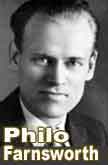
RULES Philo
Farnsworth 1906 -
1971.
What Farnsworth did for the picture image
you see on your television set, is what
Stubblefield did for the voice you hear on
your wireless cellphone and radio set.
Farnsworth Converted the Electromagnetic
Wave to Images a viewer could see on a
Television Receiver &endash; 1930
See
Radio Patent Information & Public
Demonstrations.
•••Both
Farnsworth and Stubblefield used a
continuous EMW wave to add pictures and
voice to the RF spectrum, in 1927, and
1907, respectfully, as shown in their U.S.
patents.
•••The
other 7 SMART-DAAF BOYS, utilized and
originated basic spark gap principles to
transmit dit-dah sound signals. Farnsworth
was the last of the SMART DAAF Boys to
die.
•••While
Still A Teenager, the fifteen-year-old
Farnsworth, had become excited by radio
and television after reading about Boris
Rosing's work in a magazine. He created an
electronic television system that was
superior to the mechanical discs used
experimentally at the
time.
•••
While
still in high school, he conceived the
basic requirements for television and in
his third year at Brigham Young
University, Provo, Utah, he began research
into the process of picture
transmission.
•••
•
1926 - In
1926, at the age of 20, he cofounded
Crocker Research laboratories, to market
his electronic television camera tube, he
had just applied a patent for. The camera
tube later became known as an image
dissector.
•••
The
camera tube created an image by producing
an electronic signal that corresponded to
the brightness of the objects being
televised. Farnsworth demonstrated the
image dissector in
1927.
- Continue
For More
Click on any Image to
View Warner Bros Story and Patents
1.
Feature
(Excerpt
from)
"The SMART-DAAF BOYS"™ •
•
Continued
from above
-Philo
Farnsworth was born to Lewis and Serena
Farnsworth on August 19, 1906 in Beaver
City, Utah. His parents' families were
pioneers who had travelled across the
United States on wagon trains to Utah to
help found the Mormon religion. In order
to broaden their children's educational
backgrounds, Philo's parents subscribed to
technical magazines which so much
stimulated their son's interest that at
the age of six, he declared he wanted to
become an inventor.
•••
While
still in high school, he conceived the
basic requirements for
television.
While
attending Brigham Young University, Provo,
Utah, Farnsworth
started working as an office boy for
George Everson, (later his biographer) --
who was head of the Community Chest Drive
in Salt Lake City.
•••
He mentioned his
ideas about television to Everson who
became enthused by the young man's
genius
and his research into the process of
picture transmission.
As Everson puts it,
"he rounded up a group of San Francisco
backers who put up $25,000,"
and
cofounded the Crocker Research
laboratories with the yourg 20 year
old.
•••
In
1926, Farnsworth applied for a patent on
his electronic television camera tube.
Later, in the
summer of 1927, Farnsworth demonstrated to
his Crocker
Research lab
backers,
the camera tube which created an image by
producing an electronic signal that
corresponded to the brightness of the
objects being televised.
•••
By
1928, Farnsworth demonstrated the fully
developed image
dissector. The
"image dissector" camera tube offered a
150 line picture scanning at thirty times
a
second.
•••
Like in the early
days of Stubblefield and Marconi's
wireless telephony and telegraphy, of
1900, there were no packets of radio and
television tubes, ready made antenna's,
instant coffee and Creamora laying around,
where all you had to do was add hot water.
•••
Although the words
"radio", "television, and the terms
"antenna", "radio tubes" and "AC
alternators" did exist when Farnsworth
patented his "image dissector," it didn't
make his job any easier getting a patent
named after the term, "television". Only
Smart-Daaf Boys Marconi and Stubblefield
belong to that exclusive "wireless"
telegrapy and telephonly club.
•••
In fact, to make
telephony talk in a big way, it took over
eighteen years, starting in 1892, just to
get the government to patent the first
Wireless Telephone™. It took another
90 years, in 1996 -- before the first
group of Wireless Telephone™
frequencies were sold to the general
public, by the FCC for billions of
dollars.CLICK
TO SEE 1907 AUTO PATENT
DRAWING. 02
/
TIMELINE
- Philo Farnsworth •
1906 - Philo Farnsworth (b: August 19,
1906 - d: March
11, 1971).
Farnsworth was born in Beaver, Utah on
August 19, 1906. He died in Salt Lake
City, Utah on March 11, 1971. •
1919 - Vladimir
Zworykin, the adversary of Farnsworth, in
the 30s, escapes to the United States in
1919, after the Russian revolution.
Zworykin as a graduate student in St.
Petersburg, having been the assistant of
Boris Lvovich Rosing, (1869&endash;1933)
-- a Russian scientist and inventor in the
field of television. In 1907, Rosing
envisioned a TV system using the CRT on
the receiving side, and although it used a
CRT, its operation was electromechanical
instead of purely electronic (as all
modern televisions derived from the
Farnsworth invention are). •
1921 - While
Still A Teenager, the fifteen-year-old
Farnsworth, had become excited by radio
and television after reading about
Rosing's work in a magazine. He created an
electronic television system that was
superior to the mechanical discs used
experimentally at the
time. •
1926 - While
still in high school, he conceived the
basic requirements for television and in
his third year at Brigham Young
University, Provo, Utah, he began research
into the process of picture
transmission. •
1926 - In
1926, at the age of 20, he cofounded
Crocker Research laboratories, to market
his electronic television camera tube, he
had just applied a patent for. The camera
tube later became known as an image
dissector.
•••
The camera tube
created an image by producing an
electronic signal that corresponded to the
brightness of the objects being televised.
Farnsworth demonstrated the image
dissector in
1927. •
1927 - In
1927, he formed, Farnsworth Television,
Inc. (1929) which later known as
Farnsworth Radio and Television
Corporation (1938). All of these
corporations stemmed from his first
company which he cofounded in 1926, the
Crocker Research laboratories. •
1927 - In
1927, Farnsworth successfully transmitted
an image, (a dollar sign) - composed of 60
horizontal lines and submitted his first
television patent. He subsequently
invented numerous devices, including
equipment for converting an optical image
into an electrical signal, amplifier
tubes, cathode-ray tubes, electrical
scanners, electron multipliers, and
photoelectric materials. He also
contributed to the development of radar
systems, vacuum tubes, and the generation
of electrical energy by atomic fusion. •
1927 - Since
the networks won't likely re-enact
Farnsworth's big moment, you'll have to
visualize it for yourself. The setting:
his modest San Francisco lab where, on
Sept. 7, 1927, the 21-year-old self-taught
genius transmitted the image of a
horizontal line to a receiver in the next
room.
•••
Later that day, he triumphantly wired one
of his backers in Los Angeles: "THE DAMNED
THING WORKS!"
•••
It worked -- just like Farnsworth had
imagined when, as a 14-year-old Idaho
farmboy already obsessed with inventing
television, he had been plowing a field
and realized an image could be scanned
onto a picture tube the same way: row by
row. •
1927 -
On January 7, 1927, Farnsworth
filed for his first patent application.
This was the beginning of a continuous
series of patent applications which he had
to file in order to protect each
improvement on his invention. •
1930 -
Finally, on August 26, 1930
after many gruelling months of legal
battles and financial worries
(Farnsworth's backers spent over $30,000
on the case), the twenty-four year old
Farnsworth was issued patent number
1,773,980 which covered broadly his system
of television and reception. MORE
SEE STORY
PEOPLE •
1930 - Farnsworth
granted patent. Philco TV. Its lawyers, in
proceedings claiming interference, sharply
questioned Farnsworth for many hours, but
failed to break him down. He got his
patent in 1930, when he was twenty-four
years old. During the early 1930s, Philco
became Farnsworth's chief backer. •
1931 -
In may, 1931 David Sarnoff,
president of RCA paid a visit to
Farnsworth's San Francisco lab to find out
whether Farnsworth and his backers would
consider selling the patent, laboratory
and Farnsworth's services for $100,000.
They were refused outright. •
1931 -
Philco and Farnsworth Deal. In
June, 1931, Farnsworth and his backers
entered into a licensing agreement which
gave the Philco Company (the largest
manufacturer of radios at the time) the
licensing rights for television receiver
sets. This necessitated a move to
Philadelphia for Farnsworth and most of
his staff where they occupied a Philco
laboratory at the Ontario and C Street
plant. •
1931 -
MAXWELL'S
ETHER THEORY DIES - November, 13,
1931. The one-hundredth anniversary of
Clerk Maxwell's birth was marked by the
scientific world "digging a grave for the
theory of a luminiferous ether," but at
the same time honoring Maxwell's
mathematical genius. •
1933 -
Cathode Tube. While working at
Philco, Farnsworth began to develop his
"multipactor" tube which had the ability
to transmit television impulses and could
be used as well as an amplifier, detector,
rectifier, and multiplier tube. It was the
first "cold cathode" tube and it was
hailed by scientists and engineers as a
major breakthrough, •
1934 -
In the summer of 1934,
Farnsworth and his men decided to leave
Philco and establish their own separate
laboratory, while remaining in
Philadelphia, which was then the center of
the radio industry. They turned their
attention towards developing a practical
demonstration unit for television. •
1935 - Never
mind the record says different. In 1935
the courts ruled on Farnsworth's patent,
which RCA was contesting as part of
Sarnoff's endless campaign of litigation,
propaganda and dirty tricks. The decision,
upheld on appeal: Farnsworth, not RCA's
chief television engineer Vladimir
Zworykin, is the father of TV. •
1936 -
TV Transmissions. Farnsworth
and invited him to England by John Logie
Baird, a Scotsman who was the other
developer of a workable television system
based on the revolving disk. At the
Crystal Palace in London Farnsworth's
demonstration (in which he transmitted a
signal that was picked up 25 miles away)
was such a success that Parliament voted
to have the British Broadcasting Company
(BBC ) start television service for the
London area. The Baird Company and Marconi
EMI were chosen by the BBC to be the
suppliers for television. •
1936 -
Farnsworth and Berlin to make
a licensing agreement with Fernseh AG, who
worked closely with the Baird Company.
Fernseh was headed by Dr. Paul Goerz who
had been appointed by the German Reich as
the co-ordinator for radio and television,
although he was not a Nazi. •
1936 -
During Farnsworth's German
trip, a disastrous fire swept through the
Crystal Palace and destroyed all of the
Baird equipment which had been based on
Farnsworth's work. It was a huge
disappointment for the inventor who
returned sadly to Philadelphia with a
distorted piece of melted glass. This
represented all that was left of
Farnsworth's dissector tube which would
have been used in the camera made ready
for the first broadcast. •
1937 -
Fernseh, American Telephone
and Telegraph (AT&T) signed an
agreement with Farnsworth July 22, 1937
giving Farnsworth and AT&T the right
to use each other's patents. These three
agreements helped solidify Farnsworth's
reputation with worldwide recognition •
1937 - PATENT - Farnsworth's U.S. Patent
2,089,054 Patent Granted"Incandescent Light Source" Filed March
9, 1936, Granted August 3, 1937.CLICK TO VIEW
PATENT. •
1938 -
With the advent of World War
II however, Farnsworth's close working
relationships with the Germans and the
British dwindled as the presidents of both
of these companies were called to serve
their countries. •
1938 - Although
Farnsworth was able to show a remarkably
clear image of over a foot square to the
Franklin Institute, Philco became restive
as expenses mounted. When costs passed a
quarter of a million dollars, a lot of
money in Depression days, Philco pulled
out. Farnsworth's money men tried to sell
his patents outright in 1938. •
1939 - PATENT - Farnsworth's U.S. Patent
2,1849,10 Patent
Granted
"Cold Cathode Electron Discharge Tube"
Filed Nov. 4, 1936, Granted Dec. 26,
1939.CLICK TO VIEW PATENT.
•
1939 - Farnsworth and RCA •
1939 - In
1939, RCA obtained a license from
Farnsworth to produce electronic
television transmission systems that
combined his technology with theirs.
Farnsworth later conducted research on
radar and nuclear energy. Zworykin And
Sarnoff went to California a couple of
months later -- to see what Philo was up
to in his laboratory. Later Zworykin was
said to have claimed that RCA wouldn't
need anything Farnsworth had done. Then
RCA's tough chief, David Sarnoff, came to
take a look. He echoed Zworykin. But later
RCA found that it very badly needed some
of Farnsworth's patents and paid for
rights on a royalty arrangement.
•••
The young American and the Russian emigre
worked contemporaneously, though
separately, to develop television. When
Farnsworth applied for an electronic
television patent he really shook RCA,
whose laboratories under Vladimir Zworykin
had long been struggling with the problem.
RCA challenged the application. •
1940 - PATENT - Farnsworth's U.S. Patent
2,221,374 Patent
Granted"X-ray Projection Device" Filed March
22, 1937, Granted Nov. 12, 1940.CLICK TO VIEW PATENT.
•
1941 - Pearl
Harbor and Radar Equipment. But the price,
due to high development costs, was over a
million dollars and they were
unsuccessful. The syndicate then decided
to go it alone and bought the Capehart
Corporation in Fort Wayne, Indiana, to
manufacture television sets. But Pearl
Harbor ended any such possibilities and
Farnsworth's company built radar equipment
instead. •
1941 - PATENT - Farnsworth's, U.S. Patent
2,263,032 Patent
Granted"Cold Cathode Electron Discharge
Tube.
Filed Nov. 4, 1936, Granted Nov. 18,
1941.
CLICK TO VIEW
PATENT. •
1942 -
For years Farnsworth and his
partners had refused to get involved with
the manufacturing of television sets, yet
they finally broke this barrier when they
bought the Capehart Company of Fort Wayne,
Indiana. Up to that time , Capehart had
been known best for its large coin music
boxes installed in bars, dance halls, and
restaurants. •
1957 - Farnsworth
sole appearance on national television was
as a mystery guest on the CBS game show
"I've Got a Secret" in 1957. He fielded
questions from the celebrity panelists as
they tried in vain to guess his secret ("I
invented electronic television"). For
stumping them, Farnsworth took home $80
and a carton of Winston cigarettes. •
1966 - PATENT - Farnsworth's U.S. Patent
3,258,402 Patent
Granted"Electric Discharge Device For
Producing Interaction Between Nuclei"
Filed Jan. 11, 1962, Granted June 28,
1966.CLICK TO VIEW
PATENT. •
1968 - PATENT - Farnsworth's U.S. Patent
3,386,883 Patent
Granted
"Method and Apparatus For Producing
Nuclear Fusion Reactions" Filed May 13,
1966, Granted June 4, 1968.CLICK TO VIEW
PATENT.
•
1969 -
In the late 1960s, Television
International reporter, Bob Foster, was
invited by Farnsworth's sister to visit
the inventor at his home. At that time
Farnsworth was a member of the board of
International Telephone and Telegraph
(ITT) which had taken over the
Capehart-Farnsworth Company. Wrote Foster,
" ITT was trying to acquire the American
Broadcasting Company (ABC). SEE
MORE STORY ABOUT TVI BOB FOSTER
ARTICLE. •
1971 - Forty-five
years later (and three decades after his
death in 1971), "I've Got a Secret" could
still be the slogan for Farnsworth, and
his 94-year-old widow, Pam, who worked at
his side through much of his career. •
1971 -
PHILO DIES, March 11, 1971.
Broke, Philo returned to Salt Lake City
and bought a home that he died on March
11, 1971. Although there is no inventor
single-handedly responsible for
television, Farnsworth played an extremely
important part in its history. As long as
he received his due credit, he was content
to share the limelight with his fellow
inventors, Vladimir Zworykin and John
Logie Baird. Sources: TVInews - The Story
of Television "Philo T. Farnsworth's Role
in the History of Television." Bob
Foster. •
1972 - PATENT - (Farnsworth Reference)
Hirsch's U.S. Patent 3,664,920
Patent
Granted
"Electrostatic Containment In Fusion
Reactors" Application No. 738940, Filed
June 21, 1968, Granted May 23, 1972.
Inventor R. Hirsch, Assignee: Int'l
Telephone and Telegraph Corp., Nutley ,
NJ. Reference Cited: Farnsworth 3,258,402
June 11966. Reference Cited Farnsworth
3,386,883 June 1968.
CLICK TO VIEW
PATENT. •
2002 - Emmys
2002. On
The 100th and 75th Anniversary of Radio
and TV, Hollywood Forgets One Of TheSMART DAAF BOYS --
The Inventor
and Patent Holders of Radio and
Television, Nathan Stubblefield and Philo
Farnsworth has been overlooked, as the
medium celebrates the Emmys
2002.SEE
MORE STORY IN EDITORS NOTE
/ 03
/
PATENT
NOTES
•
1931 -
MAXWELL'S
ETHER THEORY DIES - November, 13,
1931. The one-hundredth anniversary of
Clerk Maxwell's birth was marked by the
scientific world "digging a grave for the
theory of a luminiferous ether," but at
the same time honoring Maxwell's
mathematical genius.
4.
Related
Stories
/ RCA and Farnsworth- 1939 •
1939 - In
1939, RCA obtained a license from
Farnsworth to produce electronic
television transmission systems that
combined his technology with theirs.
Farnsworth later conducted research on
radar and nuclear energy. Zworykin And
Sarnoff went to California a couple of
months later -- to see what Philo was up
to in his laboratory.
•••
Later Zworykin was said to have claimed
that RCA wouldn't need anything Farnsworth
had done. Then RCA's tough chief, David
Sarnoff, came to take a look. He echoed
Zworykin. But later RCA found that it very
badly needed some of Farnsworth's patents
and paid for rights on a royalty
arrangement.
•••
Prior to coming to the United States,
Vladimir Zworykin had been Rosing's
assistant as a graduate student in St.
Petersburg, and later an officer in the
Czar's army during World War I. He escaped
to the United States in 1919, after the
Russian revolution. (Rosing was arrested
during the revolution and died before he
could make any further progress with his
ideas).
•••
The young American and the Russian emigre
worked contemporaneously, though
separately, to develop television. When
Farnsworth applied for an electronic
television patent he really shook RCA,
whose laboratories under Vladimir Zworykin
had long been struggling with the problem.
RCA challenged the application.
•••
Its lawyers, in proceedings claiming
interference, sharply questioned
Farnsworth for many hours, but failed to
break him down. He got his patent in 1930,
when he was twenty-four years old. During
the early 1930s, Philco became
Farnsworth's chief backer.
•••
Although Farnsworth was able to show a
remarkably clear image of over a foot
square to the Franklin Institute, Philco
became restive as expenses mounted. When
costs passed a quarter of a million
dollars, a lot of money in Depression
days, Philco pulled out. Farnsworth's
money men tried to sell his patents
outright in 1938.
•••
But the price, due to high development
costs, was over a million dollars and they
were unsuccessful. The syndicate then
decided to go it alone and bought the
Capehart Corporation in Fort Wayne,
Indiana, to manufacture television sets.
But Pearl Harbor ended any such
possibilities and Farnsworth's company
built radar equipment instead.
TELEVISION
and
ALEXANDERSON •
•Dr.
Alexanderson was also instrumental in the
development of television. The first
television broadcast in the United States
was to his GE Plot home at 1132 Adams Road
in 1927.
•
•
Over his lifetime, Dr. Alexanderson
received 345 patents, the last awarded in
1973 at age 94. The inventor and engineer
remained active to an advanced age,
working as a consultant to GE and RCA in
the 1950s.
•
•
Dr. Alexanderson Was a prolific inventer
and his inventive genius touched many
different fields. Some of his inventions
in communication included the magnetic
amplifier, the electronic amplifier, the
multiple tuned antenna, the anti-static
receiving antenna, radio altimeters,
television in 1928, and in 1924 the first
facsimile across the Atlantic, which
included a hand written greeting to his
father in Sweden. In other fields such as
power and control, he designed single
phase motors for railway electrification,
used by Pennsylvania R.R. system, worked
out a system for regenerative breaking of
direct current series motors used on the
St. Paul R.R. locomotives. The amplidyne
and thyratron motors were among some of
the 320 patents issued to him during his
46 years with General Electric Co. (One
for every month, give or take a few
days).
•
•
Dr. Alexanderson retired in 1948 -- but
continued as a consultant for another
year. He was 97 when he died on May 14,
1975, at his home in Schenectady, N.Y. Dr.
Alexanderson was widowed twice, and was
survived by his third wife Thyra and son
Werner; also three daughters and nine
grandchildren.
•
•
In 1983, he was inducted into the National
Inventors Hall of Fame.
Television
International Magazine's Jump Bar
-- It Goes Directly To Linked Web
Pages ReturnˆTo
Top We Preserve
The Moment Yes90
tviNews S90
109
Philo
Farnsworth (1906-1971)
is
the "F" in"Smart daaF
Boys"
The
inventors that put the Pizzazz in
Radio Wave. Biography and
TimeLine of Farnsworth Career.
(Get free copies of Marconi -
U.S. Wireless Telephone
Patents)
Feature
Story / • alexanderson
/
Smart90, lookradio, nbs100,
tvimagazine, vratv, xingtv,
Ddiaries, Soulfind,
nbstubblefield, congming90,
chinaexpo, vralogo, Look Radio,
China Expo, Soul Find, s90tv,
wifi90, dv90, nbs 100, Josie
Cory, Publisher, Troy Cory,
ePublisher, Troy
Cory-Stubblefield
/
Kudoads,
Photo Image665, Movies troy cory
show duration:medium:free - 4
min
- Television With No
Borders


 •
• •
•