|
•
|
 1.
Feature Story / A three
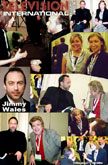
year journalistic journey with Jimmy Wales, the
founder Wikipedia, by Pete Allman. 1.
Feature Story / A three
year journalistic journey with Jimmy Wales, the
founder Wikipedia, by Pete Allman.
Wikipedia writes that Jimmy Donal "Jimbo" Wales,
(born early August 1966 in Huntsville, Alabama --
is an American Internet entrepreneur known for his
role in founding Wikipedia and other wiki-related
projects, including the charitable Wikimedia
Foundation and the for-profit company Wikia, Inc.--
MORE
ABOUT Wiki & Jimmy
Wales
• •
"To begin with"
says . . . Pete Allman, of tvinews, "I'm going
to clarify the policy of our 51 year old company,
Television International Magazine founded by Sam
Donaldson and Al Preis -- in 1956, and since that
year, nobody has faced the thought of losing their
bio-people profile because they expressed an
opinion about our
publication."
• •
For the last couple of
years, to be safe side, we now follow the
guidelines of Wikimedia's disclosure facts that
contain language specifying that customers can't
hold them accountable for service disruptions
resulting from circumstances beyond their
control.
• •
In Wiki's case, the
popular Internet profile include: "acts of God,
acts of third parties, fires, floods, strikes or
other labor-related
disputes."
• •
Their competitors have
much gloomier outlook by stating that customers are
on their own in the event of not only including:
"acts of God and fire, but: explosion, vandalism,
nuclear disaster, sun spots, solar flares,
terrorism . . . Insurrections, riots,
wars."
• •
"We're just trying to
be as clear as possible," Allman
said.
• •
As for Wikipedia,
don't go crying to Wiki-editor when your Wiki
access goes out amid an insurrection of your
bio-message by a Wiki-editor. Try not to say
anything unkind -- if you
can
• •
If you're displeased
with the way a company treats you, you're free to
air your feelings in public, right? Not necessarily
if you receive high-speed Internet access from a
staunch follower of
Wikipedia.
• •
Buried deep within
Wikipedias' voluminous files of rewrites is
language that says your Wikipedia access can be
terminated for any behavior that Wikimedia believes
might harm its "name or reputation," or even the
reputation of its business partners.
/02.
More /
To be safe,
though, like both Wikimedia's and TVInew's
disclosure facts, Profile4, the new start-up
bio-message Internet company, sent notices to
thousands of new customers revising their service
contracts with VATS, a video, audio, text and
WiFi187 media distribution facility.
•••
It follows an incident last month in which
Wikimedia blocked a free speech-rights study group
from uploading text messages to the company's
network, deeming the messages too promotional, as
more fully stated in the above "Quote Message".
•••
Profile4 and Wikimedia say they've never enforced
the can't-criticize-us contract terms, which have
been in place for years.
•••
But the provisions highlight yet again the danger
to free expression when a relative handful of
private companies serve as gatekeepers to
information networks.
•••
How free is free speech in the digital era?
•••
Whether it's a rock star ranting against President
Bush, within the Bush Wiki Profile web page, or a
disgruntled user griping about shoddy service.
•••
"Not being able to speak your mind about something
is contrary to public policy," said Frank
Tuerkheimer, a law professor at the University of
Wisconsin who focuses on Internet-related
issues.
•••
But it's apparently not illegal. The 1st Amendment,
Tuerkheimer pointed out, doesn't apply to Wiki's
private entities, All Wiki's text is licensed under
the GNU free documentation licensed (GFDL).
•••
All text on Wikipedia is licensed under the GNU
Free Documentation License (GFDL). Over 100 sites
using Wikipedia for content have been identified,
and categorized by their degree of compliance, at
Wikipedia: GFDL Compliance. Wikipedia:Mirrors and
forks has more information, including what to do if
someone is violating the GFDL license.
•••
Free content, or free information, is any kind of
functional work, artwork, or other creative content
having no significant legal restriction relative to
people's freedom to use, redistribute, and produce
modified versions of and works derived from the
content.
•••
Free content encompasses all works in the public
domain and also those copyrighted works whose
licenses honor and uphold the freedoms mentioned
above. Because the law by default grants copyright
holders monopolistic control over their creations,
copyrighted content must be explicitly declared
free, usually by the referencing or inclusion of
licensing statements from within the work.
•••
(Work in the public domain cannot be licensed
because, by definition, its copyright has expired
or has been relinquished. However, such a work is
still considered free content, because it may be
used for any purpose whatsoever &emdash; except,
naturally, being re-copyrighted.). --
MORE
STORY --
http://en.wikipedia.org/wiki/Free_content
•••
You have to wade deep into Wikimedia's user's
contract to find the one-line disclaimer in which
the company reserves the right to slam the door on
any Internet customer who might bruise the
company's feelings.
•••
Along with specifying behavior that is
"self-promtional, defamatory, fraudulent, obscene
or deceptive," the contract says service may be
suspended or terminated for any behavior that
"tends to damage the name or reputation of
Profile4, Yes90 -- [Profile4's online
partner] or their respective parents,
affiliates and subsidiaries."
•••
In Wikimedia's case, you have to make it all the
way through the company's several web-pages of
explaination, to weed out the out the "acceptable
use of its policy."
•••
This is where customers are informed that, among
other things, they aren't allowed to post material
online that's "obscene, indecent, pornographic,
sadistic, cruel or racist in content, or of a
sexually explicit or graphic nature; or which
espouses, promotes or incites bigotry, hatred or
racism."
•••
It's also where the company says customers are
similarly crossing the line if they "damage the
name or reputation of Wikimedia, its parent,
affiliates and subsidiaries, or any third
parties."
•••
A Profiles4 spokesman, said the language was there
"to stop people from setting up websites that look
like their's" or engaging in other ploys frequently
used by scammers to con people into revealing
personal info, including Social Security and credit
card numbers.
•••
Pete Allman said he understood that some people
might view the language as a right to censor
customers' opinions, particularly when such
opinions might trample on TVInews's good name.
•••
"But whether or not it's interpreted that way is
irrelevant," he said, "because we've never used it
that way. Actions speak louder than words."
•••
That wasn't a very persuasive argument for Kurt
Opsahl, senior attorney at the Electronic Frontier
Foundation, a San Francisco advocacy group focusing
on digital-rights issues. "If they're not going to
use it, then why have it?"
•••
Profile4, stresses that the company had no plans to
censor customers. "We respect our customers' right
to express themselves as they see fit."
Part
03 /
• So
why have the language in customers' contracts?
•••
"The policy is what it is," attorney Scott S
replied. "This is common brand language designed to
protect the brand."
•••
Actually, not all broadband providers claim such a
right. For example, a spokeswoman for Time Warner
Cable said the company had no policy addressing
termination of customers' accounts just because
they might say mean things.
•••
Profile4's user contract language will be
continually revised in the future -- to reflect a
more free-speech-friendly mind-set.
"Wiki" is the Hawaiian word
for quick, and it refers to a website that can be
updated easily by anyone from any Web browser. The
first wiki armature was developed in 1995, and
Wikipedia -- the brainchild of one Jimmy
Wales -- was founded
in 2001. Under Wales' brilliant conception, anyone
can go into Wikipedia (wikipedia.org) and create a
new article or edit an old one: It is entirely
accessible and entirely
alterable.
• •
This is anarchy, of course, and completely
antithetical to the encyclopedic tradition, which
has emphasized a kind of solemn definitiveness and
authority. Britannica and Encarta, for instance,
not only employ experts to write their articles but
subject everything they publish to a rigorous
review process. At Wikipedia, you (or any old
maniac) can march right onto the "nuclear fusion"
page and add your
thoughts.
• • But as Wikipedia says about
itself, the point is not that it's hard to make
mistakes but that it's easy to correct them.
Because thousands of people -- ordinary, unpaid,
outside participants -- monitor and edit Wikipedia,
errors and vandalism are often corrected in
seconds. One feature of the site is a list of
recently updated pages, so that one can keep track
of changes. One can even revert to a previous
version of an article if mistaken or malevolent
parties have messed it
up.
• • The result is not perfect. In
one brief instance, a character from "Star Wars"
was labeled Benedict XVI. But such is the
exception, not the rule, and usually quickly
rectified. Overall, the encyclopedia gets ever
larger and ever more accurate. The English version
has grown to more than half a million entries, and
in checking the "recent changes" section I once
found a dozen or more revisions every minute. The
site also provides contexts in which changes can be
proposed and discussed among
writers.
• • So is it to be trusted? Does
it have the credibility of Britannica? Well, I have
monitored over a decent period a number of entries
on matters about which I know something and have
found them almost invariably accurate. And I have
watched some of them grow, becoming ever more
elaborate and
interlinked.
• • In fact, open architecture is
in some sense the only possible way to do what an
encyclopedia purports to do: represent the state of
human knowledge in real time. Such a project is by
its nature so huge that it requires what Wikipedia
has: thousands of experts, editors, checkers and so
on with expertise in different fields working over
a period of years. Also, Wikipedia, unlike the
World Book, for example, or even Encarta, is
updated continuously. When we use the term "public
property," we usually mean state property, but
Wikipedia compromises the concept of ownership
without dispossessing anyone: It is truly public
property.
• • What is perhaps most
fascinating about Wikipedia is its demonstration in
practical anarchy. It is an ever-shifting,
voluntary, collaborative enterprise. If it is in
the long run successful, it would show that people
can make amazing things together without being
commanded, constrained, taxed, bribed or punished.
• • There are people who want to
deface or even destroy Wikipedia. The right-wing
blogger Ace of Spades -- out of mischief and
because he heard Wikipedia's operators were
liberals -- recently called on its readers to
"punk" the site to put up as much misinformation
and nonsense as possible. Other blogs gleefully
expose errors, even if those defects persist only
for a few minutes.
• • If the vandals are successful,
they'll more or less confirm the common wisdom that
people are too evil and miserable to be allowed to
govern themselves.
• • What is perhaps most
fascinating about Wikipedia is its demonstration in
practical anarchy. It is an ever-shifting,
voluntary, collaborative enterprise. If it is in
the long run successful, it would show that people
can make amazing things together without being
commanded, constrained, taxed, bribed or punished.
• • There are people who want to
deface or even destroy Wikipedia. The right-wing
blogger Ace of Spades -- out of mischief and
because he heard Wikipedia's operators were
liberals -- recently called on its readers to
"punk" the site to put up as much misinformation
and nonsense as possible. Other blogs gleefully
expose errors, even if those defects persist only
for a few minutes.
• • If the vandals are successful,
they'll more or less confirm the common wisdom that
people are too evil and miserable to be allowed to
govern themselves.
• • But if Wikipedia grows into
the greatest reference work ever made, it will
suggest that great things are possible when you
merely let people go and see what happens.
4.
Related Stories
May 4, 2005 / ASK
Jimmy Wales
anything and Crispin Sartwell of
Dickinson College in Carlisle, Pennsulvania says
Wikipedia is the best.
Encyclopedias -- whether paper (Britannica, for
example) or software (Encarta) -- are intended to
be representations of the scope of human knowledge
at the moment of their publication. This idea, of
course, has a long history. But the most
interesting thing about it may be its future, as
represented by the magnificent, nonprofit
Wikipedia. MORE
STORY, dated May 4,
2005.
First
TVInews Wikipedia Story - Founder Jimmy Wales -
2005
•
113
Q&A and Rules on How To Write or Update a
Yes90, Wikiquote News Article about, "People and
Things". Hints in preparing for your first
article for Yes90 -- using guidelines from
Wikipedia, the free encyclopedia.
MORE
•
113
My Wikiquote using a Yes90 news category, about
people, the law, and as to the reasons why --"They
Said It ! " Welcome! Editing your first Yes90
Article for a Wikiquote should be a cinch. You've
followed a link to a blank page that doesn't exist
yet. MORE
STORY
5.
NBS100 Review WiFi / Land-lines
NBS100
TeleComunication Study - Regulatory Frequency
Seizure
More
Articles • Converging
News OCTOBER 2007 / TeleCom BuyOuts, Spinoffs and
Asset Seizure Boom
Respectfully
Submitted
Josie
Cory
Publisher/Editor
TVI Magazine
•
• TVI
Magazine, tviNews.net, YES90, Your Easy Search,
Associated Press, Reuters, BBC, LA Times, NY Times,
VRA's D-Diaries, Industry Press Releases, They Said
It and SmartSearch were used in compiling and
ascertaining this Yes90 news
report.
•
• ©1956-2008.
Copyright. All rights reserved by: TVI
Publications, VRA TelePlay Pictures, xingtv and Big
Six Media Entertainments. Tel/Fax: 323
462.1099.
We Preserve The
Moment
Return
ˆ
To
Top
|
•
|





 •
• •
•