"THE
DEAL TO STEAL 2012"
?
•••
While it
would appear to be a rather
simple matter to determine how
many countries there are in the
world, it is in fact quite
complex. This is due not only to
the ever-shifting political
landscape, but also because the
term
‘countries’
is somewhat fluid and open to
interpretation.
•••A
narrow definition of what a
country is might look at a
well-established group
– such as the
United
Nations
– and take its
list of recognized members. In
the case of the United Nations,
there are 193 recognized states,
with 192 being members of the
United Nations, and the Vatican
City, which is a permanent
observer with all rights of a
member, save voting rights. (Continued
below)
Continued:
•••One
could also take an established definition
for what a state is, and find all states
which match those criteria. The most
widely-accepted definition is given by the
Montevideo Convention, from 1933. By these
guidelines, a state must have a
government, be in a position to interact
with other states diplomatically, have a
defined territory, and possess a permanent
population.
•••
A rough count of these states would place
the number of countries in the world at
201. That includes the 193 states
recognized by the United Nations, as well
as eight additional states. These are the
Western
Sahara, Taiwan,
Northern Cyprus, Somaliland, South
Ossetia, Transnistria, Abkhazia, and
Nagorno-Karabakh. These states meet the
criteria set out by the Montevideo
Convention, but are all in a struggle with
another, larger state, for independence,
and so far have not been formally
recognized by the United Nations.
•••An
even broader definition could include some
states which have been recognized by a
number of countries, but have either
failed to establish a steady government,
or have failed to receive recognition by
enough fellow states to truly meet the
criteria of the Montevideo Convention. By
adding in states such as the Cook Islands,
Palestine, or the Chechen Republic, one
could get to a much greater number of
countries in the world
– somewhere in the
range of 210-230.
•••
Going even broader, one can include
countries that are part of a larger
country, sometimes referred to as
constituent countries. One obvious example
of this would be the countries of
England,
Scotland,
Wales, and Northern Ireland
– all making up the
single country of the United Kingdom. In
most counts of the countries in the world,
these four countries are counted as one,
but they could easily be counted as four
instead. By including these sorts of
countries there could be many hundreds, if
not thousands, of countries in the world
– especially if one
were to start counting smaller states,
such as California or Delaware in the
United States, as independent in their own
right.
•••Similarly,
territories – such as
the territory of Guam, a possession of the
United States – are
usually not counted in an official count,
but are states by many criteria. These are
referred to by the United Nations as
Non-Self Governing Territories, and
include an additional 16 territories.
•••So,
how many countries are there in the world?
193 by the count of the United Nations.
193 also by the count of the United States
Department of State. 201 by a tight
interpretation of the Montevideo
Conventions. Somewhere over 220 by a
looser interpretation. And if we were to
go by the number of countries that have
their own domain suffix
– such as .us for the
United States, or .de for Germany
– we would find 243. So
there is no firm answer, but 193 is
commonly accepted, and somewhere between
193 and 250 seems rather
certain.
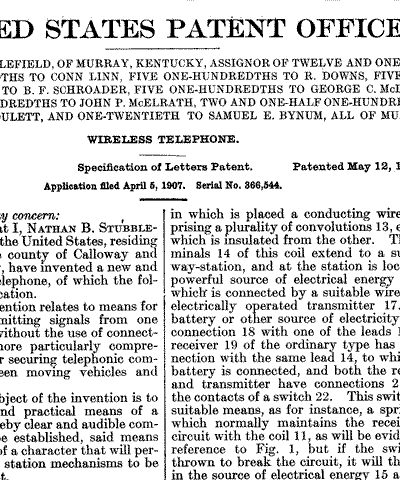
Photo 01:
On May 9th 1908, an American inventor called
Nathan Stubblefield was awarded a patent for the
world's first ever mobile telephone in Murray,
Kentucky USA. Nathan was a true pioneer, he had
been experimenting with wireless telephones for a
few years, managing to send his and his son's voice
between early telephones through the ground and
even through water! No one apart from Nathan really
understood at the time how his invention worked; he
was a real showman but would never give away his
secret.
Part
02h
Photo
02: CLICK PHOTO FOR
MORE
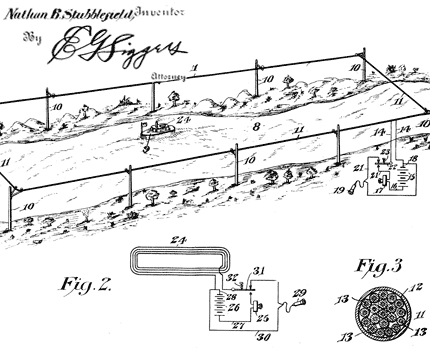
/ Nathan's early devices
used lots of coiled wires to transmit and receive
the phone signals between two devices, so much wire
in fact that if he just ran wire between the phones
anyway he would have had plenty to
spare!
Part
03h
/
Searching Virgin Media With Google
CLICK
PHOTO FOR MORE PHOTO 01 03.
CLICK PHOTO FOR
MORE
- Photo 03: NBS's
86 acre Teléph-on-délgreen Industrial
School, now Murray State University, MSU. Nathan is
pictured with his family. Note his WitTel and WiFi
antenna in background, upper right.
Part
04h/•
Photo 04:
CLICK PHOTO
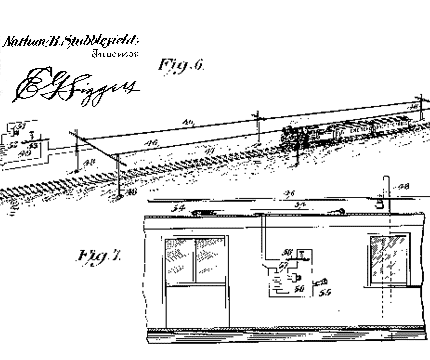
FOR MORE / When Nathan won his patent
for a 'wireless telephone,' his device was made up
of wire suspended between poles and a transmitter
was placed on top of a train, carriage or even a
boat.
Part
05h -
NBS100
Vehicular Review WiFi WiMax Towers Copper Wire
Connection / Land-lines Photo 05:
CLICK PHOTO FOR
MORE / When the vehicle
was near the transmitting wire, the signal carrying
sound went through the air to the device and could
be heard on the other end through a
phone.












 •
• •
• •
• •
• •
• 44
44 60
60 70
70 •
• 80
80 •
• •
• •
•
